Jordan Gray
Anne of AvonleaJordan Gray is a figure in Avonlea’s remembered past whose character is revealed chiefly through his devotion to Hester. He brought her from the city to a quiet farm, made her a garden she loved, and cared for her as her health failed. Their shared life there lasted four years; after her death, he left Avonlea, but was eventually brought back to rest beside her.
Background and Marriage
Jordan was the only son of David Gray, an older farmer who did not live on the farm that would become Jordan’s home. While working in Boston one winter, Jordan fell in love with Hester Murray, who worked in a store and longed to return to the countryside where she had been brought up. She agreed to marry him on the condition that he take her somewhere quiet, among fields and trees. Jordan brought her to Avonlea, and his father gave him the farm. Although Rachel Lynde regarded his marriage to a Yankee as a risk, Hester was remembered as pretty and sweet, and Jordan as wholly devoted to her.
The Farm and Hester’s Illness
Jordan built a small house on the farm, where he and Hester lived for four years. Hester seldom went out, and few people visited her apart from Diana Barry’s mother and Rachel Lynde. The garden Jordan made for her became the center of her life: she spent much of her time among its flowers and had a particular talent for growing them, though she was not a capable housekeeper.
As Hester grew progressively weaker, Diana’s mother believed she had already been suffering from consumption before she arrived in Avonlea. Hester never fully took to her bed, and Jordan refused to let anyone else wait on her. He cared for her himself with exceptional tenderness, wrapping her in a shawl each day and carrying her out to the garden to rest on a bench. At her request, the two prayed together every morning and evening that she might die there when her time came.
Hester’s Death and Jordan’s Return
That wish was fulfilled in the garden. One day Jordan carried Hester out to the bench, gathered the roses that were blooming, and heaped them over her. She smiled up at him and died. The account, told by Diana years later among the garden’s narcissi, makes Jordan’s care visible in its ordinary acts as well as its final gesture: he had carried Hester outside day after day, and at the end surrounded her with the flowers she loved.
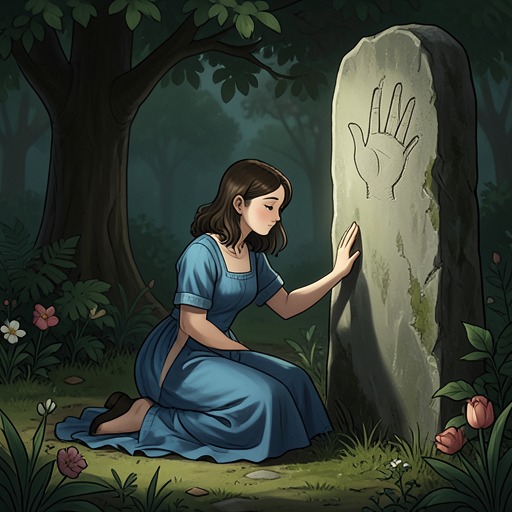
After Hester’s death, Jordan sold the farm and returned to Boston. Jabez Sloane bought the property and moved the little house to the roadside. Jordan died about ten years later; his body was brought back to Avonlea and buried beside Hester. Her small brown gravestone, carved with opening gates and an inscription giving her age as twenty-two, marked her grave in the poplar corner of the graveyard. Jordan lay next to her without a stone of his own.
Memory and Significance
Jordan’s life reaches the reader through a story passed down in Avonlea, rather than through scenes he narrates himself. The garden preserves what ordinary local memory had nearly lost: Diana remarks that the events happened thirty years earlier and that everyone had forgotten. Its flowers have spread until they carpet the ground, making the former site of Hester’s private happiness newly discoverable to Anne Shirley and her companions.
Anne Shirley interprets Hester’s choice of seclusion as a desire to escape the noise and indifference of the city, not as a rejection of human companionship in general. She considers Hester fortunate to have had four years of happiness and to have died among roses with the person she loved beside her. Jordan’s story therefore survives not only as a record of grief, but as an account of the quiet life he helped Hester choose and the tenderness with which he shared it.